
The amazing Gum 17, 18, 19 & 20 + Stars Over Bucks + LRGB
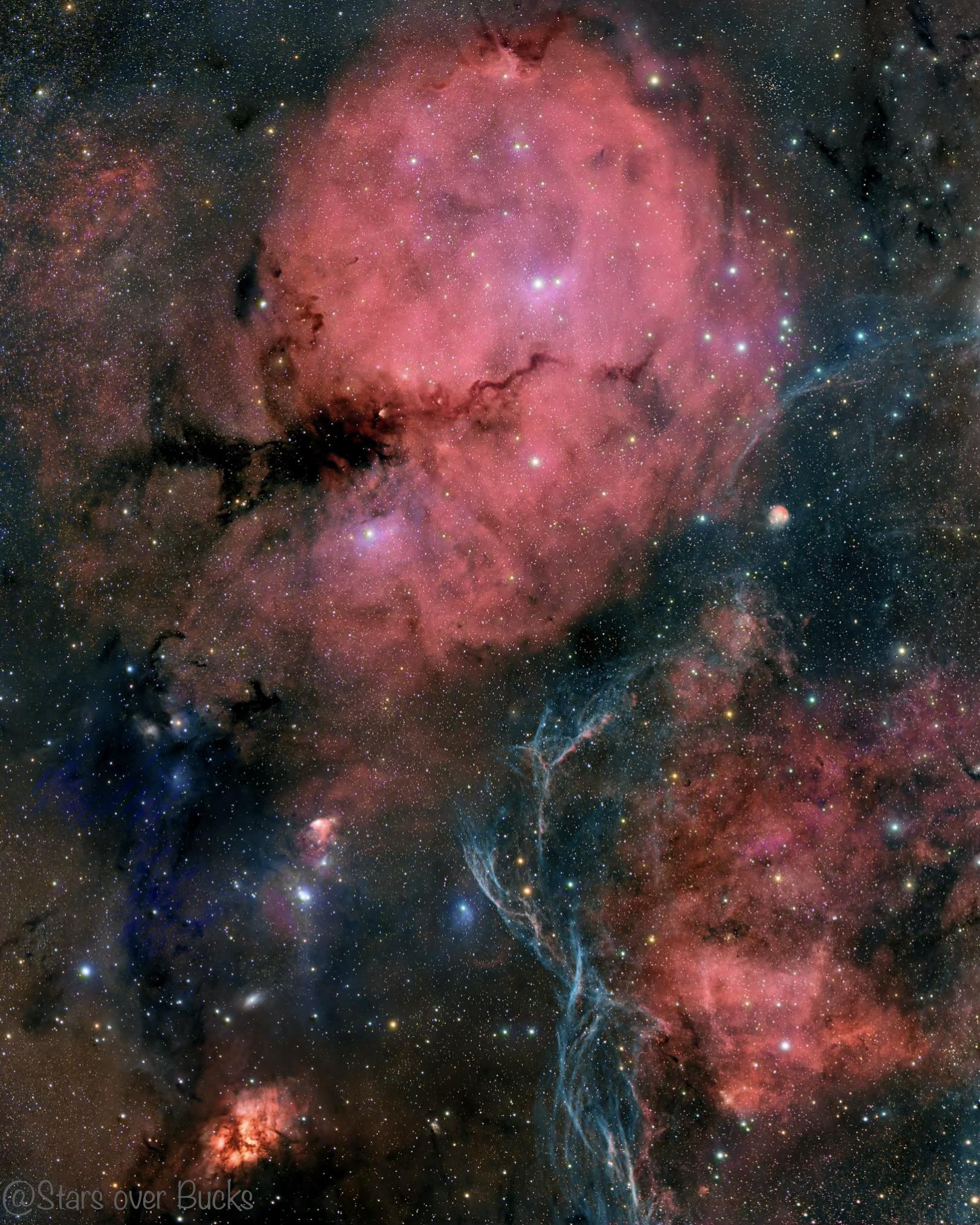
The amazing Gum 17, 18, 19 & 20
Credit: Stars Over Bucks
Filters: Optolong LRGB filters
The amazing Gum 17, 18, 19 & 20 — a spectacular stretch of emission nebulae embedded deep in the southern Milky Way.
These objects are part of the extensive catalog compiled by Australian astronomer Colin Gum in 1955, documenting large hydrogen emission regions across the southern sky.
Distance: Roughly 3,000–6,000 light-years away (estimates vary by region, as these nebulae span a large section of the Sagittarius–Carina arm).
Size: Together, they extend across hundreds of light-years of interstellar space. The apparent size on the sky covers several degrees — far larger than the Moon — which makes this a true wide-field target.
Composition: Primarily glowing hydrogen (Hα emission), mixed with interstellar dust lanes and pockets of ongoing star formation. Embedded star clusters and hot, young O- and B-type stars provide the ultraviolet radiation that causes the gas to fluoresce.
You can also see some of the fine filaments from the Vela Supernova Remnant.
One of the fascinating aspects of this region is how it reveals the large-scale structure of our galaxy. These nebulae aren’t isolated clouds — they’re part of a vast star-forming complex tracing the spiral arm itself. The intricate filaments and dark dust rivers show stellar feedback in action, as radiation and stellar winds sculpt the surrounding gas.
This was captured with my remote telescope in South Africa (KKRO) using 20 hours of exposure time.
Telescope: Askar FRA400 f/3.9
Camera: Zwo ASI 2600MM Pro
Exposure: 140 x 6min L,20 x 6 min RGB
Mount: Zwo AM3
Guiding: ASI120mini, 30mm scope
Filter: Optolong LRGB
Software: NINA, DSS, Pixinsight
Hope you like it.